Fitting
I have always tended to be “stout,” as they say; “fat” to someone who is inclined to make such judgments. As a kid, I could not wear blue jeans; in order to get some that would fit me in the legs (thighs), the size would have to be hopelessly too big in the waist and/or too long.
Apparently, this predicament was common enough, because by the time I was 10 or 11 years old, the jean companies marketed jeans that were tailored to my situation.
I have imagined the scene at the jean company. The guy in product development, who suffered a “slacks wearing” childhood, develops the jeans that would fit, and the company loves his idea. Imagine the designer’s mixed feelings of joy and shame when the marketers decide to designate his new jeans (and him) as “HUSKY.”
The coaches took delight in referring to me at times as “heavy hocks,” but the cut of my jeans was impeccable.
And so I learned, as a well-dressed HUSKY, that the circumstance of “fitting” or “not fitting,” like most circumstance, can be an elusive and ambiguous matter indeed; consistently, I learned the importance in conventional wisdom of “fitting,” as well as the circumstance of “not fitting” that has made me at various times a malcontent, a sociopath or a prophet, or something of all of them.
I observed a time from my adolescence in the 60’s and 70’s when “not fitting” was all the rage: “Tune In, Turn On, Drop Out.” Even then, it seemed obvious to me that it was far too important for the hippies to “fit in” by “not fitting,” and to follow the “counter” conventional wisdom of the “counterculture” As a result, it was not completely surprising to see that group elect Ronald Reagan as president and become some of the staunchest “fitters” of American history; the group that set the humankind record for irony by tearing down the Berlin wall in the name of peace and love, only to establish the MacDonald’s Empire worldwide, “One world, under FREE ENTERPRISE, with a Big Mac and french fries for all.” A part of me was right there with them – there in my HUSKY hip-huggers – until I traded them in for a three-piece suit and an office at Fulbright & Jaworski law firm. I never voted for Reagan, but I marveled at the end of the cold war, the apparent peace and the spoils of victory – covered, of course, with lots of ketchup.
It turns out that it is not so easy not to fit, even among the HUSKIES and the hippies.
Also interesting is the relationship of “fitting” to “being fit.” No matter how hard the “fitters” try to control events – how much they invest, how many policeman and soldiers they have -- who their friends are – the “fittest” seem to be the ones who don’t quite “fit.”
The survivors, heroes and progenitors are often freaks. My favorite hero, Jesus, is perhaps the best example; the Sermon on the Mount is something like Jimi Hendrix’s “raise your freak flag high!” Who “is fit,” for the Kingdom of Heaven? – those who do not “fit” in the Kingdom of Earth. No one less than God could make this stuff up.
I have to ask if “fitting” is such a dubious distinction, why is its importance so tenaciously advocated? Why are the important ones, the misfits, so persecuted? Why do we turn nature on her head to persecute the “fit”? Don’t history and Jesus tell us to celebrate the nonconformists instead (and not just posthumously)?
Closely related to the preoccupation with “fitting” is the fear of being “lost;” The “fitters;” shake their heads at the misfits and bemoan, “…the poor soul is just lost.” An interesting concept, I think – one either “fits,” or is “lost.”
I preached to mom and to Nan about being “lost” long before I had any notion of geography or, for that matter, philosophy. “Lost” meant not believing in Jesus. To me at that time, believing in Jesus meant believing in myself. As it came to occur to me that I might not “fit” in some way, the thought of being “lost” became more ominous; husky and imperfect, I was not to be counted on. Of course, that development opened many doors – husky jeans and the real Jesus could come along and I could be “SAVED AT LAST.”
That is, I was taught that the antidote for being “lost” was to be “saved.” Regardless of the nomenclature, “lost” was geographic – not on the road to heaven -- and “saved” was simply following directions. So, whether it was husky jeans or the real Jesus, “saved” was a process of fitting – following the prescribed sartorial, philosophical, moral, cultural, religious, social roadmap for the promised reassurance of good grooming, eternal life, goodness, beauty, heaven or what other goodies might be unavailable or unattainable for a “lost” soul. Yet, whether it was husky jeans or Christianity, “saved” or “fitting” didn’t do much to change the qualities of my body or my character; at the point of that realization is when I think I could truly appreciate the feeling of, and meaning of “lost,” and the consideration of “lost” as a way of life.
A few years back, my wife and I were in Paris; it was a first-time visit for both of us. We happened on a little square near Montmartre, a hill with a beautiful cathedral. In the square there were a number of artists painting all kinds of wonderful things. After the fact, I found out the significance of this spot for artists, the likes of van Gogh, Picasso, Degas and other notables had occupied those spots we saw on that day. We came upon an artist who was painting portraits from photographs, and came up with the wonderful idea of commissioning a portrait of our grandson. Of course, the photograph we needed was back at the hotel. We rushed with great excitement to the hotel and en route back for this great adventure. We had prided ourselves on mastering the Paris subways but, despite all skill and efforts, found ourselves unable to locate the square.
“You are lost,” Kathie stared at me.
No doubt in a manner of speaking she was absolutely right. Yet, I was taken aback by the accusation. Here I was in an utterly foreign place, with only the vaguest notion of my location and, for that matter, where I was actually going. It struck me that “lost” was a very odd way to assess my/our predicament. That is, when you don’t know where you are, and you don’t know where you’re going, “lost” doesn’t seem to have much relevance. The particular situation was soon exacerbated in my attempts to ask a Frenchman directions in English.
On the other hand, I believe that is the sense of “lost” for which the true antidote is being “saved.” It is a matter of condition rather than location. It is a place in which what is needed is not so much a set of directions, which might be utterly unintelligible to me in my particular circumstance, but rather a change of perspective or orientation. Perhaps it is like a point of consciousness on an infinitesimally small particle in a near infinite universe asking, “Where Am I?” or “Why Am I here?” or “Is There Some Other Point of Consciousness – Maybe God?”
My sense of this condition of “lost” has evolved over my life experiences. I do not believe that I am unique in that regard – we may see this development in many contexts – failed relationships, disease, death, career setbacks, even good luck or wealth. It is not surprising that we go to our doctors, our pastors, our lawyers, our parents and ask for a “prescription,” “orthodoxy,” or the law. Like the french roadmap handed to me in the middle of Paris, it is also not surprising that these directions often simply do not work to “save” me from being “lost.”
So it is that “fitting” may not necessarily “save” me from being “lost.” Maybe that is why we say, “Misery loves company.” Maybe that is why Jesus said that the misfits are blessed, and would “inherit the earth” – a particularly reassuring vision of the rapture in which most of the rising souls are wearing husky jeans…
Thursday, January 22, 2009


Crying
I feel like crying right now.
The heaviness on the edge of my eyes,
That means it’s dangerous to blink.
It’s not that I can’t take it like a man,
I just can’t seem to take it any other way.
Mad as hell,
I sit here staring
In both directions,
Out there,
In here.
A man feels that way,
When he can’t fix it.
A man might cry
When “it” seems like everything.
Everything is like
The heart within me.
I read that we hiccup
Because we are still part fish.
Ancient lineage.
I wonder, “Is that why
We have to cry?”
Adam might ask Jesus,
“Was it worth it?”
Jesus might ask Adam
The same thing.
Neither answers,
And God’s not talking again.
I think I’ll cry right now,
Like an old woman
At the wailing wall.
Spirit given up,
Tears falling down,
Worship and Sacrifice.
The heaviness on the edge of my eyes,
That means it’s dangerous to blink.
It’s not that I can’t take it like a man,
I just can’t seem to take it any other way.
Mad as hell,
I sit here staring
In both directions,
Out there,
In here.
A man feels that way,
When he can’t fix it.
A man might cry
When “it” seems like everything.
Everything is like
The heart within me.
I read that we hiccup
Because we are still part fish.
Ancient lineage.
I wonder, “Is that why
We have to cry?”
Adam might ask Jesus,
“Was it worth it?”
Jesus might ask Adam
The same thing.
Neither answers,
And God’s not talking again.
I think I’ll cry right now,
Like an old woman
At the wailing wall.
Spirit given up,
Tears falling down,
Worship and Sacrifice.
Wednesday, January 21, 2009
Inauguration
It is ironic that we have become a nation of slaves, and that we would now turn to a black man for liberation. We are addicted, indentured, indebted, stripped of fundamental rights and ruled by terror - slavery by any estimation. And so perhaps Obama is truly one of us, or we are truly within his heritage. In any event, it seems that Obama's message speaks to us out of the spirit of the civil rights movement which spirit is now not so much about color, though it is still that, but more about raising our spirits out of the chains that bind us. The shackles are strong, the masters, they are mustering their power and caucusing in the big houses. We must consider the ends and the means. Freedom is more than security or economy or even democracy. Freedom is about integrity of the spirit, responsibility, respect and even love. Such things cannot be institutionalized nor imposed lest they lose reality and meaning; such things cannot be won by the sword lest the fundamental principles be fundamentally corrupted; such things cannot be awarded or bestowed, but must be earned by the sweat of our brows, the earnest application of our intellect and unpretentious and humble respect and commitment to the will and the nature of God. I believe that this is the calling and I pray that we will hear and take up our plowshares.
Friday, December 19, 2008
Christmas 2008
Here I am,
At the end of a road
Again.
The lights
Of just another Bethlehem,
Ornaments
Like tiny stars --
A cold wind.
They tell me
Over and over,
There’s just no room at the Inn.
Not a single, solitary place
To be sheltered in…
I see a tear
On Mary’s cheek.
So tired,
The Baby
Just can’t sleep,
He cries out
From His altar –
When He came here
Looking
For a manger.
How could He know
What
We would do to Him?
A story
Is more than paper,
Like something
In a package
Under the tree.
We wonder
And shake it --
Hope what it
Will be.
Maybe a baby
A gift
To you and me.
Here I am,
At the end of a road
Again.
The lights
Of just another Bethlehem…
Star bright, Star light
What will I see tonight?
Here I am,
At the end of a road
Again.
The lights
Of just another Bethlehem,
Ornaments
Like tiny stars --
A cold wind.
They tell me
Over and over,
There’s just no room at the Inn.
Not a single, solitary place
To be sheltered in…
I see a tear
On Mary’s cheek.
So tired,
The Baby
Just can’t sleep,
He cries out
From His altar –
When He came here
Looking
For a manger.
How could He know
What
We would do to Him?
A story
Is more than paper,
Like something
In a package
Under the tree.
We wonder
And shake it --
Hope what it
Will be.
Maybe a baby
A gift
To you and me.
Here I am,
At the end of a road
Again.
The lights
Of just another Bethlehem…
Star bright, Star light
What will I see tonight?
Thursday, December 4, 2008
Advent and Christmas
I believe that advent ("the waiting") is the time for our preparation for the experience of remembering and celebrating creation. To me, creation is the very essence of Christmas. The union of the reality of our human existence and that creative spirit in the nature of things; the offspring that is me, as I look in the mirror, and beyond me, as I look beyond the mirror, beyond my cognition, beyond even the powers of my cognition. As a Christian, I struggle to relate to what it must have been like to be Jesus, the thoughts... the feelings... the fears... the hopes... the love... so that I might better follow Him. Such a daunting enterprise... so, at this time of year I celebrate the simplest, most beautiful, most mysterious image of all our experiences... the baby.
The Baby is Jesus. The angels sing, the universe pays homage... and so do I.
I realize that the "real" time of Christmas can be, like other times, very different from the "meaning" of Christmas. So, "real" Christmases in the shopping malls, in the midst of our dysfunctional culture, government, economy, familes and personal lives are often all the more poignant and sad; hopes of peace, love, beauty, "the Baby" seem so far away and even silly. In his ministry, over and over Jesus spoke to all kinds of people seemingly caught in their lives, caught in "real" Christmases, and he said, "stop, look, listen... their is a kingdom of heaven at hand all around you." In that kingdom, that is right here and right now, there are angels singing, shepherd's tending their flocks, wise men coming from the East and there is "the Baby."
Jesus message is difficult to swallow, perhaps especially at Christmas. There is no natural (as in laws of nature), moral, theological, cultural or other imperative from God, Jesus or any other authority that imposes Christmas, in its essence, upon us. To be in the "kingdom of heaven" is a choice, and a difficult one at that. It is a choice beyond rational, beyond feelings that we feel comfortable with... ultimately a matter of faith; faith so strong that, as Jesus put it, we must be willing to or even really "die" in some sense to experience it.
The stories, like our lives, can be hard, unlike the story of the Baby in the manger at Bethlehem. And so, in advent, we must prepare ourselves to leave those stories behind. We must look deep within our spirits, look into the stars in the skies, look at what is beautiful and enduring in the midst of and in spite of everything. We must raise our eyes to the heavens and prepare to sing with the heavenly host. The power of God. The image of the Baby Jesus.
Creating Christmas: Discovering the Sacraments of the Nativity
I recently read an account of the Christmas story in Newsweek, an article analyzing the biblical accounts in historical perspective; questioning the proof for the related events.
It was a very respectable and thoughtful article for its purpose, “… we can see that the Nativity saga is neither fully fanciful nor fully factual but a layered narrative of early tradition and enduring theology… .”
The Christmas story told in Matthew and Luke is certainly retrospective and second-hand information. There is no contemporaneous narration. Nor do any of the accounts of Jesus teachings or actions specifically refer to or enlighten us about the actual events at his birth. One can surmise, like the author of the Newsweek article, that this status of our knowledge about the events of the Christmas story, in general, and the lack of any first hand account, more specifically, results from the fact the importance of the events was not and really could not have been recognized contemporaneously. It is certainly true that for the most part the participants in the recounted events were not of social, political or other status to expect that they would have provided written accounts, or that others around them would have deemed their lives and activities “newsworthy.”
My reaction is not quite so glib. In any event, to me, to analyze the Christmas story as literal history versus literary exposition misses the point. God could certainly have included an eyewitness account had He seen fit. Moreover, as I thought about it, the approach we have to take through the available information to understand or otherwise “process” Christmas seems to be, in and of itself, part of the story.
Recently, there was a group of infamous trial lawyers whose notoriety came from outlandish aggressiveness. Whenever a witness would attempt to offer evidence of his/her name, birthdate or other such identifying information, the lawyers would vigorously make objection – hearsay! What can a person know about such matters other than what they have been told?
So, as we mature into self-awareness, we create the first chapters of our life stories, the foundation of our identities, from the bits and pieces of historical and second-hand information that comes to us from family, photographs, and all kinds of sources. It is this kind of information that plays a seminal part in my creation of me.
The Christmas story is an account of creation. Genesis is cosmology – an account of God creating and participating in the universe. Christmas is genealogy -- an account of our spiritual lineage. I look at the Christmas story like looking into a baby book. There are the snapshots, the footprints, the swaddling cloth… -- as real as the wounded flesh that Thomas demanded for his belief. As unreal as life itself – in the manger or after the cross. God, here among us, here within me.
If I am to be a Christian, I must weave those images into myself and make them real in my own life. It is Jesus’ baby book; it is my own spiritual baby book. Creating Christmas in me is the manner in which grace, forgiveness, love, everlasting life – everything Jesus stood for – are born in me. These are God’s Christmas presents, to be unwrapped and used as I might strive for the potential that is both beyond and within me.
How do you create the innocence, beauty and audacity of birth – even your own birth? What do you know about the being you see in the baby book? Creating Christmas is not easy. It is a task we do not often have the stomach for, since we have become so different, so occupied by other things, so preoccupied by fears, doubts and maturity. Let us ponder the lessons, analyze the historical data, reach out for Jesus’ wounds… .
I think Scrooge finds out that creating Christmas is about the aesthetic, not the empirical experience of things. In our aesthetic sense, there are ghosts and there are angels, there are stars that give directions, there are kings from faraway kingdoms bearing gifts, there is a Holy Presence which is the fountain of all procreation… . To say “aesthetic” is not to deny the literal, but to recognize that the literal is not all of the story. God’s reality is the palette on which we are drawn in perspective with all creation, in all shades of color and light. We know that is true with every image on every Christmas card that we have ever carefully selected to send that special Christmas message.
The angels, the songs, the stable, the manger, the shepherds, the wise men … these are the sacraments of Christmas -- those special ornaments we unpack and admire every year in those special places -- those things from the baby book that tell us who Jesus was, who we are. They are sacraments of mysterious and real truth. It is the truth beyond understanding. The truth of Joy, Love, Peace and Goodness -- the truth of the Baby Jesus.
I believe that God’s promise, through Jesus, is that if we will believe in these things, if we will participate in these sacraments, then they will become a part of us – the enduring part of us, the perfect part of us that will be welcomed into God’s own family.
The Baby is Jesus. The angels sing, the universe pays homage... and so do I.
I realize that the "real" time of Christmas can be, like other times, very different from the "meaning" of Christmas. So, "real" Christmases in the shopping malls, in the midst of our dysfunctional culture, government, economy, familes and personal lives are often all the more poignant and sad; hopes of peace, love, beauty, "the Baby" seem so far away and even silly. In his ministry, over and over Jesus spoke to all kinds of people seemingly caught in their lives, caught in "real" Christmases, and he said, "stop, look, listen... their is a kingdom of heaven at hand all around you." In that kingdom, that is right here and right now, there are angels singing, shepherd's tending their flocks, wise men coming from the East and there is "the Baby."
Jesus message is difficult to swallow, perhaps especially at Christmas. There is no natural (as in laws of nature), moral, theological, cultural or other imperative from God, Jesus or any other authority that imposes Christmas, in its essence, upon us. To be in the "kingdom of heaven" is a choice, and a difficult one at that. It is a choice beyond rational, beyond feelings that we feel comfortable with... ultimately a matter of faith; faith so strong that, as Jesus put it, we must be willing to or even really "die" in some sense to experience it.
The stories, like our lives, can be hard, unlike the story of the Baby in the manger at Bethlehem. And so, in advent, we must prepare ourselves to leave those stories behind. We must look deep within our spirits, look into the stars in the skies, look at what is beautiful and enduring in the midst of and in spite of everything. We must raise our eyes to the heavens and prepare to sing with the heavenly host. The power of God. The image of the Baby Jesus.
Creating Christmas: Discovering the Sacraments of the Nativity
I recently read an account of the Christmas story in Newsweek, an article analyzing the biblical accounts in historical perspective; questioning the proof for the related events.
It was a very respectable and thoughtful article for its purpose, “… we can see that the Nativity saga is neither fully fanciful nor fully factual but a layered narrative of early tradition and enduring theology… .”
The Christmas story told in Matthew and Luke is certainly retrospective and second-hand information. There is no contemporaneous narration. Nor do any of the accounts of Jesus teachings or actions specifically refer to or enlighten us about the actual events at his birth. One can surmise, like the author of the Newsweek article, that this status of our knowledge about the events of the Christmas story, in general, and the lack of any first hand account, more specifically, results from the fact the importance of the events was not and really could not have been recognized contemporaneously. It is certainly true that for the most part the participants in the recounted events were not of social, political or other status to expect that they would have provided written accounts, or that others around them would have deemed their lives and activities “newsworthy.”
My reaction is not quite so glib. In any event, to me, to analyze the Christmas story as literal history versus literary exposition misses the point. God could certainly have included an eyewitness account had He seen fit. Moreover, as I thought about it, the approach we have to take through the available information to understand or otherwise “process” Christmas seems to be, in and of itself, part of the story.
Recently, there was a group of infamous trial lawyers whose notoriety came from outlandish aggressiveness. Whenever a witness would attempt to offer evidence of his/her name, birthdate or other such identifying information, the lawyers would vigorously make objection – hearsay! What can a person know about such matters other than what they have been told?
So, as we mature into self-awareness, we create the first chapters of our life stories, the foundation of our identities, from the bits and pieces of historical and second-hand information that comes to us from family, photographs, and all kinds of sources. It is this kind of information that plays a seminal part in my creation of me.
The Christmas story is an account of creation. Genesis is cosmology – an account of God creating and participating in the universe. Christmas is genealogy -- an account of our spiritual lineage. I look at the Christmas story like looking into a baby book. There are the snapshots, the footprints, the swaddling cloth… -- as real as the wounded flesh that Thomas demanded for his belief. As unreal as life itself – in the manger or after the cross. God, here among us, here within me.
If I am to be a Christian, I must weave those images into myself and make them real in my own life. It is Jesus’ baby book; it is my own spiritual baby book. Creating Christmas in me is the manner in which grace, forgiveness, love, everlasting life – everything Jesus stood for – are born in me. These are God’s Christmas presents, to be unwrapped and used as I might strive for the potential that is both beyond and within me.
How do you create the innocence, beauty and audacity of birth – even your own birth? What do you know about the being you see in the baby book? Creating Christmas is not easy. It is a task we do not often have the stomach for, since we have become so different, so occupied by other things, so preoccupied by fears, doubts and maturity. Let us ponder the lessons, analyze the historical data, reach out for Jesus’ wounds… .
I think Scrooge finds out that creating Christmas is about the aesthetic, not the empirical experience of things. In our aesthetic sense, there are ghosts and there are angels, there are stars that give directions, there are kings from faraway kingdoms bearing gifts, there is a Holy Presence which is the fountain of all procreation… . To say “aesthetic” is not to deny the literal, but to recognize that the literal is not all of the story. God’s reality is the palette on which we are drawn in perspective with all creation, in all shades of color and light. We know that is true with every image on every Christmas card that we have ever carefully selected to send that special Christmas message.
The angels, the songs, the stable, the manger, the shepherds, the wise men … these are the sacraments of Christmas -- those special ornaments we unpack and admire every year in those special places -- those things from the baby book that tell us who Jesus was, who we are. They are sacraments of mysterious and real truth. It is the truth beyond understanding. The truth of Joy, Love, Peace and Goodness -- the truth of the Baby Jesus.
I believe that God’s promise, through Jesus, is that if we will believe in these things, if we will participate in these sacraments, then they will become a part of us – the enduring part of us, the perfect part of us that will be welcomed into God’s own family.
Thursday, November 6, 2008
44:44 and the Mason Dixon line
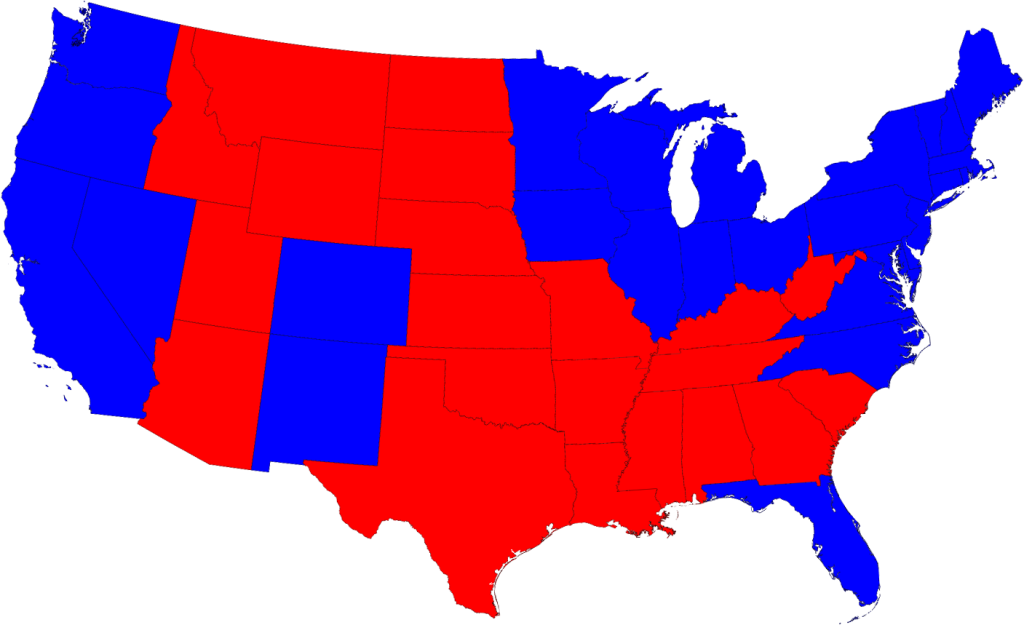
Before we get too euphoric about a new age of unity, change and the future of our nation, consider geography. If we look at a map of the alignment of states and the location of the territores at the civil war, and compare with the 2008 electoral map, the division of the north states and south states is eerily similar. Kansas, West Virginia and Missouri go to the south (McCain). Virginia goes to the north (Obama). Florida (now New York south) goes north (Obama). North Carolina is too close to call. Remember at the time of the Civil War a big controversy was over how to admit the new states without tipping the balance of power. The Missouri Compromise sought to avoid war by evenly dividing the territories into allies of north and allies of south. Note the almost even division of territories from the civil war map compared to the electoral map. Colorado, Nevada, New Mexico and Washington to north (Obama). Arizona, Indan territory, Nebraska territory, Dakota territory and Utah to south (McCain). So we have to wonder if we have progressed, or if we are simply replaying the history of our basic divisions. By the way, that division in 2008 is very close 52-48%, on a good day for the democrats. We know the division was very deep in 1860, deep enough to fight a bloody and cruel war. How deep is the division, still about the same in territory and numbers, today? I think it is very important in view of this to consider the nature of the division. Part of the division at the civil war was certainly about race. With the election we have a feeling that things have changed, but looking at the map have they really? I think the answer is certainly things have changed in the south, but we cannot overestimate the lingering effect of racism in shaping the 2008 map. Part of the civil war was about urban vs. rural. That seems unquestionably similar to today; Obama won in the old south territories because he captured the new urban centers in those old southern states. Part of the civil war was about industry vs. agriculture. To me that is the least analogous area. Certainly, increased industrialization of the south does not seem to have overshadowed other factors to align those industrialized southern areas with the north. Ironically, the south remains the bible belt vs. the less fundamentalist Christianity and more cosmopolitan nature that might be attributed to the north. To a serious Christian like myself, this is very troubling. It appears on the map almost unmistakable that fundamentalist Christianity is still linked to heritages that include lingering influences of racism and rural resistance to the problems, influences and changes that dominae the emerging world.
I would not for a minute ignore the monumental possibilities that seem to be hinted at in the current election. But I cannot look at the map and not also realize the serious dangers and challenges that face us.
2008 election:
election:
I would not for a minute ignore the monumental possibilities that seem to be hinted at in the current election. But I cannot look at the map and not also realize the serious dangers and challenges that face us.
2008 election:
election:
Wednesday, November 5, 2008
Leadership
It's quite an election. I'm wondering if this is happening because it's the right time, or it's the right time because the right guy has come along. I'm thinking for other black pioneers, breaking the race barrier was just the beginning of the story. Jackie Robinson, for instance, had to be better than white baseball players, in all kinds of ways, in order to succeed as a major league baseball player; any failure, even a temporary or predictable shortcoming, would have been used to confirm racial stereotypes of the day. I'm hoping it is different for Obama. It is an impossible job in the first place. He may or may not excel in whole or in part; he may or may not fail in whole or in part. We need to be past the point at which the judgment of his performance in this job will be a report card for the inherent qualities of his race. We need for race not to be the issue of his presidency. I think it may be the right time because of the black pioneers that have come before him, and the heritage and perspective they have given all of us; I think of Booker T. Washington, Martin Luther King, Jr., Jackie Robinson, Bill Cosby, Opray Winfrey - and many, many others who have weaved into and enriched the fabric of our culture, for their race and beyond their race for all of us. I think he might be the right person because of his apparent calmness and confidence in the eye of the perfect storm.
For some reason this morning I thought about president Kennedy's announcement, May 21, 1961, that the US would put a man on the moon by the end of the decade. By any objective analysis, this was nothing more than "trash talk" aimed at the Soviets who seemed to have taken an advantage in the cold war by launching their rocket. Yet, we did it. The world we know today has been shaped by the technology, knowledge, spirit and confidence engendered by that effort.
In the end, I think that the true measure of leadership is in reaching for goals beyond our grasp. Encouraging us to do merely what it is clearly within our abilities and strengths turns out to be just cheerleading.
So, when there seems to be so little to cheer about, what we clearly need is a leader.
For some reason this morning I thought about president Kennedy's announcement, May 21, 1961, that the US would put a man on the moon by the end of the decade. By any objective analysis, this was nothing more than "trash talk" aimed at the Soviets who seemed to have taken an advantage in the cold war by launching their rocket. Yet, we did it. The world we know today has been shaped by the technology, knowledge, spirit and confidence engendered by that effort.
In the end, I think that the true measure of leadership is in reaching for goals beyond our grasp. Encouraging us to do merely what it is clearly within our abilities and strengths turns out to be just cheerleading.
So, when there seems to be so little to cheer about, what we clearly need is a leader.
Subscribe to:
Posts (Atom)